Bored Piles (Cast-in-situ Piles)
02.Bored Piles (Cast-in-situ Piles):
Flexible and Strong Foundations
Bored piles, also known as cast-in-situ piles, are deep foundation elements created by excavating a circular hole in the ground and then filling it with reinforced concrete. They are one of the most versatile and widely used deep foundation systems globally, capable of supporting extremely heavy loads.
The Installation Process
The process typically involves:
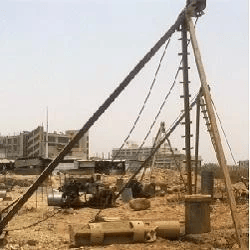
- 1. Drilling: A drilling rig (like a rotary rig) excavates the soil to the specified depth and diameter.
- 2. Stabilization: To prevent the collapse of the bore walls in unstable soil, temporary steel casings or stabilizing slurries (such as bentonite) are used.
- 3. Reinforcement: A pre-fabricated steel reinforcement cage is lowered into the hole.
- 4. Concreting: Concrete is placed using a tremie pipe from the bottom up, ensuring a dense, continuous, and void-free pile shaft as the casing or slurry is withdrawn.
Key Advantages
Bored piles offer significant benefits, making them suitable for complex urban projects:
- • High Load Capacity: They can be constructed to very large diameters and depths, offering superior vertical load-bearing capacity for tall buildings and heavy infrastructure.
- • Minimal Vibration: Since soil is removed rather than displaced (unlike driven piles), the installation causes minimal noise and ground vibration. This makes them ideal for use near existing structures, heritage buildings, or sensitive urban environments.
- • Adaptability: The length and diameter of the pile can be easily adjusted to suit changing ground conditions encountered during drilling, ensuring the pile tip is founded on the optimal bearing stratum.
Bored piles provide a secure, adaptable, and low-disturbance solution for ensuring the stability of critical structures.
Subscribe Newsletter
© 2025. copyrights. All Rights Reserved. Designed by Justsee
Scroll to Top